
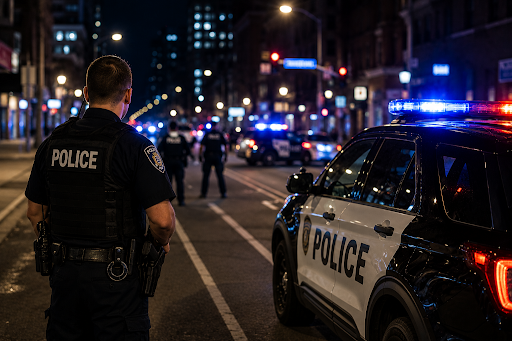
An overnight callout reshuffles the next day’s posts. By the morning brief, the schedule on paper isn’t the schedule on the road. Here’s why the cascade matters more than the original callout, and how to make police officer scheduling run on rails instead of memory.
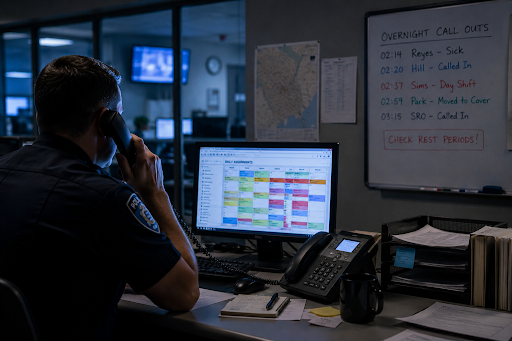
02:14 AM. Officer Reyes calls in sick from the back half of the midnight shift. The watch commander has fifteen minutes to make four decisions, in the dark, on the phone, with a dispatcher waiting for orders.
Six hours later, the day-shift sergeant walks in, opens the printed schedule, and starts assigning posts that have already been reassigned by people who went home before the sergeant arrived. Half the assignments are wrong before the morning brief starts.
This is a cascade failure. And it’s the single most common reason departments end up paying overtime on shifts they didn’t think were short.
The cascade nobody calls out by name
The original callout is one event. The cascade is the chain reaction it sets off:
- Officer Reyes calls out at 02:14.
- The Watch Commander calls Officer Hill from the rest list. Hill comes in at 03:00 on overtime.
- Hill was scheduled for the day shift today at 07:00. Now, Hill needs to be replaced or the day shift starts short.
- The Watch Commander calls Officer Sims for day-shift backfill. Sims agrees, but won’t be in until 09:00.
- Day shift starts at 07:00, one officer short. The Sergeant moves Officer Park from a school crossing patrol to cover. The crossing post is now empty.
- The crossing post needs coverage by 08:00. A school resource officer is pulled in.
One callout. Six police officer scheduling changes. None of them logged in the same place. None of them are visible to the next shift’s sergeant when they walk in.

Where the cascade goes wrong
Cascades fail in three predictable ways. Each one creates a different problem.
The eligibility list is stale
The watch commander grabs the printed callout list. Three officers on the list are on vacation, in training, or already over their OT cap. The list hasn’t been refreshed since Monday. The commander makes calls that go to voicemail or get refused, burning fifteen minutes on people who couldn’t have come in anyway.
Result: the right officer gets called fourth instead of first. The response window expands. And, the cascade arrives later in the night with fewer good options.
The downstream impact isn’t visible
The watch commander pulls Officer Hill in. The commander knows Hill is scheduled tomorrow, but isn’t tracking that pulling Hill in early creates a rest-period conflict for Hill’s day shift. The schedule update happens, the rest-period flag never fires, and Hill works through a violation that nobody catches until payroll runs.
Result: a grievance two weeks later, a contract violation, or both.
The change doesn’t propagate
The 02:00 schedule changes get scribbled on a clipboard, called into dispatch, or noted in a Watch Commander’s email. The day-shift sergeant arrives at 06:30 and is reading a schedule that’s been outdated for four hours. The morning brief assigns posts that have already been reassigned. By 07:30, every supervisor is having the same conversation, “Wait, who’s where?”
Result: the morning brief eats an extra 20 minutes. Posts get covered late. And, the roster on paper diverges from the roster on the road for the rest of the day.
The cost of a callout isn’t the OT for the replacement. It’s what happens to the next eight hours of police officer scheduling because the cascade ran on someone’s memory.
What an automated cascade looks like
The phrase “automated callout” usually gets reduced to “send a text blast.” That’s not what we mean. An automated cascade enforces three things in sequence when scheduling police officers:
Live eligibility at the moment of the call
When the callout starts, the system pulls the current eligibility list, not last week’s list. Officers on vacation are filtered out. Officers over their OT cap are flagged. Officers on a rest period are excluded. The Watch Commander sees the actual top five candidates, ranked by contract rotation, with current status.
Downstream conflict checks before commitment
Before the Watch Commander commits Officer Hill to the 03:00 call, the system flags that Hill is scheduled at 07:00 and shows the rest-period implication. The Commander either chooses someone else or knowingly authorizes the rest-period exception. And, the exception gets logged with the reason. No silent contract violation.
Live propagation to the day shift
Every cascade change updates the live schedule the next Sergeant will read. By 06:30, the day-shift Sergeant is looking at the actual current state, not a printout from the day before. The morning brief assigns posts that match what’s already happened.
That’s it. Three steps. The technology has existed for years. What’s missing in most departments is the integration between the callout list, the rest-period clock, and the next shift’s roster used for scheduling police officers.
The math on a typical year
For an 80-officer department, callouts happen roughly 600 times a year (sick, family emergency, training conflict, late notice). Of those, the cascade goes wrong roughly 1 in 5 times. That’s 120 events.
Each cascade failure costs:
- 15–30 minutes of supervisor time in the morning
- One contract-rule near-miss (rest period, OT cap, post coverage)
- 0–2 additional hours of OT from a misrouted backfill
Annualized: 120 events × ~$200 average cost = $24,000 in operational drag, before counting the 1–2 grievances per year that trace back to a silent rest-period violation. Those settle for $5,000–$15,000 each.
Departments that automate this aspect of scheduling police officers typically see this number drop by 60–75% in the first six months, not because callouts decrease, but because the chain reaction stops compounding.
The conversation to have this month
Three questions to bring to your next watch-command meeting:
- When a callout happens at 02:00, who has to be reached, in what order, and how is that order kept current?
- When an officer is pulled in early for a callout, what or who checks the rest-period implication for the officer’s next shift?
- When the day-shift Sergeant arrives, are they reading the schedule that reflects what happened overnight, or the schedule that was printed yesterday?
If the answer to any of these is, “We figure it out in the morning,” the cascade is running on memory. And the cost is in the line items you’re not connecting back to it.